The monsoons are here, and with water logging a common sight around every corner, cases of people suffering from typhoid are rising. So before you reach for that yummy plate of pani puri or bhel, think about the possibility of contracting the disease.
Typhoid, also known as typhoid fever is a life threatening disease that is caused due to an infection by the bacterium Salmonella typhi. According to the CDC (Center for Disease Control) almost 21.5 million people in developing countries contract typhoid each year.
 Typhoid is usually transmitted by water or food, in much the same way as cholera. People who are infected excrete live bacteria in their feces and urine. They are usually contagious for a few days before any symptoms develop, so they don't know they need to take extra precautions. If they don't wash their hands properly, the typhoid bacillus can be transferred to food or water and from there to another person. Also, it can be spread directly from person to person via contaminated fingers.
About 3% of infected people (treated or not) become asymptomatic carriers of Salmonella typhi. This means that they continue to shed bacteria in their feces for at least a year and often for life but don't have any symptoms of typhoid. There are a small number of typhoid carriers in every country. Even Canada and the United States report dozens of locally transmitted cases of typhoid each year, though most cases in these countries are among travellers or people immigrating who are ill when they arrive.




Typhoid, also known as typhoid fever is a life threatening disease that is caused due to an infection by the bacterium Salmonella typhi. According to the CDC (Center for Disease Control) almost 21.5 million people in developing countries contract typhoid each year.
Causes :-
About 3% of infected people (treated or not) become asymptomatic carriers of Salmonella typhi. This means that they continue to shed bacteria in their feces for at least a year and often for life but don't have any symptoms of typhoid. There are a small number of typhoid carriers in every country. Even Canada and the United States report dozens of locally transmitted cases of typhoid each year, though most cases in these countries are among travellers or people immigrating who are ill when they arrive.
Symptoms :-
The symptoms of typhoid fever usually develop one or two weeks after a person becomes infected with the Salmonella typhi bacteria.
With treatment, the symptoms of typhoid fever should quickly improve within three to five days.
If typhoid fever is not treated, the condition usually gets worse over a few weeks and there's a significant risk that life-threatening complications of typhoid fever may develop. Without treatment, it can take weeks – or even months – to fully recover, and symptoms can return.
Early symptoms include fever, general ill-feeling, and abdominal pain. High fever (103°F, or 39.5°C) or higher and severe diarrhea occur as the disease gets worse.
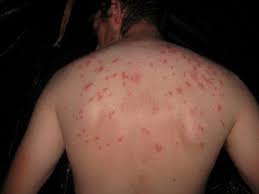
Some people with typhoid fever develop a rash called "rose spots," which are small red spots on the abdomen and chest.
- A high temperature, which can reach up to 39-40°C (103-104°F)
- Headache
- Muscle aches
- Stomach pain
- Feeling sick
- Loss of appetite
- Constipation or diarrhoea (adults tend to get constipation and children tend to get diarrhoea)
- A rash made up of small pink spots
- Exhaustion
- Confusion, such as not knowing where you are or what is going on around you
- Abdominal tenderness
- Agitation
- Bloody stools
- Chills
- Difficulty paying attention (attention deficit)
- Delirium
- Fluctuating mood
- Hallucinations
- Nosebleeds
- Severe fatigue
- Slow, sluggish, lethargic feeling
- Weakness
Home Treatment :-
- Typhoid fever causes a lot of weakness. It is advisable to take complete rest.
- Drink boiled water to get rid of typhoid fever. Drink the water when it is still warm.
- Grind 4 basil leaves, 7 black pepper tablets and 7 strands of saffron into a paste. Prepare small tablets from the paste, and take these 2-3 times during the day.
- Drinking buttermilk is a good cure for typhoid fever. Add some fresh coriander juice to it for better results.
- Mash a banana and add some honey to it. The honey-flavoured banana tastes good, helps to restore energy lost due to the illness, and aids fast recovery.
- Banana is a wonder food for recovering from the fever. Add mashed banana to a glass of butter milk and consume this daily.
- You can also consume orange juice, as it keeps the body hydrated and cool.
- Pomegranate juice also helps to rehydrate and energise a typhoid fever patient.
- You might get bored drinking the same fruit juice every day; include a variety of fruit juices in your diet. Apart from oranges and pomegranate, apples and sweet limes are also good for typhoid patients.
- Include vegetable soups in your diet. However, they should be bland; do not add any spices or condiments that might irritate the intestines. Make sure you boil the soup properly and strain it before consumption.
- A glass of warm water with a spoonful of honey added to it is a great remedy that helps to soothe the digestive system. Drink it as frequently as you can, as it also restores energy.
- Boil around 5 cloves in 2 litres of water till only 1 litre of water is left. Remove it from the stove, and let the flavour steep in for some time, and then filter. Sip this concoction throughout the day.
- It is advisable to consume food that is very easy to digest, if possible a diet of maximum liquids and fruit juices. Once the patient starts recovering, start including food items like a well-cooked khichdi, curd rice and kheer.
Ayurvedic Treatment :-
- Drinking Sweet lime (Mosambi) juice is beneficial during Typhoid.
- Eating Banana pulp mixed with Buttermilk reduces fever during Typhoid.
- Eating Californian raisin (Monakka) helps to kill typhoid causing bacteria's.
- Boil five Cloves (Laung) in water for 10 minutes filter. Drinking this decoction after cooling twice a day helps to get relief from Typhoid.
- Eating Orange and milk, thrice is also beneficial during Typhoid.
- Drinking hot water mixed with a spoon of Honey is helpful during typhoid.
- Drinking Apple juice is also advisable during Typhoid.
Homeopathic Treatment :-
- Gelsemium : In early stage. Typhoid fever, when so-called nervous symptoms predominate. Great fullness in head, with heat or face and chilliness. Head feels too big. Tongue yellowish white or thick brown. Nervous chills, with chattering of teeth and fever without thirst.
- Baptisia: Incipient stage, Face dark red, with a besotted expression. Dull, stupefying headache, with confusion of ideas. Head feels as if scattered around. Patient tosses about toget pieces together. Tongue coated brown, dry, particularly in center. All discharges are very offensive.
- Pyrogen: Severe septicanemia,the bed feels hard, parts laid on feels sore and bruishes, great restlessness. Tongue large flabby, clean smooth as if varnished, constipation, stool large, black, carrion like, pulse abnormally rapid out of all proportions to temperature.
- Hamamelis: Typhoid fever, with bloody orifis. Profuse hanemorrhage from blood black, partly coagulated and offensive, with a bruised, sore feeling in abdomen and hips. Epistaxis, flow passive.
BIOCHEMIC REMEDIES FOR TYPHOID FEVER:
- Ferrum phos – Typhoid or gastric fever when commencing; initiatory stage for chilliness. The patient has a full, flushed face and the lips and mucous membranes are red. The pulse is more rapid, but stronger and less irregular than under Kali phosphorium.
- Kli mur – Typhoid or gastric fevers, for gray or white coated tongue and looseness of the bowels, with light-yellow, ochre-colored stools or floccuent evacuations, and for abdominal tenderness and swelling.
- Kali sulph – Typhoid or gastric fever, with a rise of temperature at night and a fall in the morning.
- Natrum mur – Typhoid or malignant conditions during the course of any fever, such as twitchings with great drawsiness, watery vomiting, spoor, parched tongue, etc.
- Calcarea phos – After typhoid or gastric fevers as the disease declines.

No comments:
Post a Comment